|
The
Evereg-Fenesse Mesrobian-Roupinian Educational Society is celebrating its 125th Anniversary, on September 3, 4, and 5, 2004
(Labor Day weekend), during its 17th Triennial International Convention at the Sheraton Universal Hotel.
One would
wonder why young, modern, educated Diaspora born Armenians would dedicate themselves to propagate this "old country"
organization, and maintain its ancestral traditions with the same awe and affiliation as their immigrant parents and grandparents?
Is it in respect or nostalgia of our childhood memories at hyrenagitz (compatriotic) picnics and dances, or of our parents'
and grandparents' dedication to safeguard old traditions and history, or simply fascination of the mystery of its long abiding
spirit in our veins? For a daughter of Everegtsi mother and Fenessetsi father, asked to write about the history and growth
of this organization, unfolding the mystery revealed a culture deep in tradition and its relentless urge for education.
Starting from its geography, its history and legends, to its inception in the diaspora, Evereg-Fenesse presents the
magical mystery of faith and survival of all Armenians. Here is Our Story.
Geography & History
Evereg
is located south of Ceasaria, separated by Erjias Lehr (Arkeos as the Greeks called it), the highest mountain of the region,
covered always with snow. It is believed that Noah's Ark had first hit this mountain and the Nahabed having said, "Arachinnen
eh ahs," his words had been converted into "Erjias." Before the Turkish expansion, in the years around 1285,
Evereg had been inhabited by Greeks who had built towers on the mountain and waterways down to the towns. It was conquered
by Turkish generals Dev Ali, Kheder Elias, and Sheikh Ali, and all its Greek inhabitants massacred.
Dev Ali's followers
settled on the mountain, taking over the towers and its waters, calling the town Develi. When war was over, skilled workers
were needed for rebuilding. Armenians, being known for their skills, came and settled there, but half an hour south of Develi,
in the valley where the Greeks had built a church and a waterway running down to it from the mountain. The church had been
destroyed, but the water was available. The Turks settled on the south of that waterway. The Armenians settled on the northside,
expanding later over its hills to the other side. Armenian immigrants coming from different regions were identified by their
names; for example, those from Persia were called Barsamenk, from Tehran, Tarkhanenk, from Tomarza, Domartsook. These Armenians
co-existed peacefully with the Turks, free to practice their religion, and living on gardening and commerce.
Two
hundred years later, Armenian immigrants from Konya came to settle above the hills where the Turks' homes ended, calling it
Fenesse. So the two towns of Evereg and Fenesse, although near each other (about a 10-minute walk) were separated by Turks.
Both Evereg and Fenesse prided on highly skilled craftsmen: ironsmith, cobbler, carpenter, hairdresser, tailor, weaver, etc.
Each had its own "shooga" with many shops and stores. Each had its own church, both named St. Toros, with their
adjacent schools Evereg-Mesrobian School, and Fenesse-Roupinian School.
Origins of the Organization
The Evereg
Fenesse Farmers Union was first formed in 1861 in Istanbul to help compatriots in their region. Founded and chaired by Garabed
Panossian and Kevork Kelejian( a "gesaratsi"), it gathered 300 members of cobblers, painters, "chalmale, shalvarle,"
poor people who had come to seek work in Istanbul. The union rented two restaurants and opened one tobacco store, collecting
donations - "passing a hat at the restaurant." Six months later, it had raised 28,000 ghroosh, for the towns of
Evereg and Fenesse. This union dissolved later.
During 1870's, when a general movement among the Armenians in Istanbul
aimed at elevating the standards of education in Armenian schools throughout Turkey, the Everegtsis and Fenessetsis separately
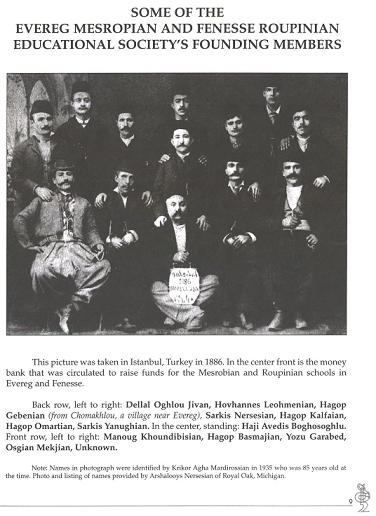
raised funds and sent qualified teachers to their homeland. Thus in 1878, were founded the Evereg-Mesrobian and Fenesse Roupinian
Educational societies, named after the schools in these two towns.
With many Everegtsis and Fenessetsis escaping
the growing strife in Turkey and moving to America, Evereg-Mesrobian was founded again in New York on October 1, 1906, extending
chapters later to other states. Many of those chapters later dissolved except for Detroit which kept sending help to its school
in Turkey till 1914. The society then sent money to its chapter in Beirut to distribute to needy emigrant families. It also
provided tuition support to elementary school students of Everegtsi or Fenessetsi descent who attended the AGBU Armenian school
in Detroit and to colleges in Michigan. "When we came to America in 1928 with my husband, there were two societies, Evereg
and Fenesse, but we attended each other's activities," explained 92-year-old Mrs. Nercessian, wife of Nercess Nercessian,
a long time secretary of the society.
When all Armenians from New York and Michigan went to California, they started
working together and suggested joining the societies. One reason, Mrs. Nercessian explained, was that as most Everegtsi and
Fenessetsi families had intermarried, the funds received from each society by their members were being duplicated. Considering
this and the fact that these two communities had lived side by side and shared the joys and sorrows of life together as one
community, the need of a merger was felt more and more strongly. Therefore, on April 17, 1955, authorized representatives
of the Mesrobian and Roupinian Associations met in New York and signed an Agreement of Unification, drawing a constitution
and by laws, which was ratified at a joint convention held on September 1, 1956.
The joint Evereg-Fenesse Mesrobian-Roupinian
Educational Society still stands to this day in many chapters in Detroit, New York, Los Angeles, and Beirut, continuing to
raise funds and supporting Armenian education and the traditions of the culture.
Evereg-Fenesse Educational Society
Celebrates 125th Anniversary on Labor Day
By Mireille Kalfayan
California Courier Online, July 29, 2004
Additional information:
Krikorian, Aleksan. Evereg-Fenesse: Its Armenian History and Traditions. Detroit, MI: Evereg-Fenesse
Mesrobian-Roupinian Educational Society, 1990. 186 pp.
|